


It took 250,000 sea snails to dye one garment. It smelled of rotting fish. And it was the most coveted colour in the ancient world.
Imagine a colour so expensive, so exclusive, and so deeply associated with power that wearing it without permission could get you exiled. A colour produced in workshops so foul-smelling they were banned from city centres. A colour that required the crushing and fermenting of hundreds of thousands of tiny shellfish to yield a single gram of pigment. That colour was Tyrian Purple — and for over a thousand years, it defined what it meant to be royalty.
From Phoenicia to Rome: The Birth of a Colour
Tyrian Purple originated in the ancient Phoenician city of Tyre, in what is now modern-day Lebanon. It was produced from the glands of the Murex brandaris shellfish — a sea snail found in the eastern Mediterranean — and coveted across the ancient world from Egypt to Rome. The production process was neither quick nor pleasant.
The shellfish were crushed, and the glands extracted and left to putrefy in vats, fermenting in seawater. The originally colourless liquid slowly turned yellow, then green, then blue-red as it was exposed to air and sunlight, finally yielding the distinctive deep reddish-purple. Dye houses fermenting thousands of sea snails were among the ancient world’s most unpleasant workplaces — the smell of rotting fish, garlic and eggs reportedly detectable from miles away.
“It took approximately 10,000–12,000 murex snails to produce just 1 gram of dye. To colour a single garment required around 250,000 snails. Small wonder it cost a fortune.”
Born to the Purple
In Rome, Tyrian Purple became so closely associated with imperial power that wearing it without the right to do so could result in exile — the phrase “born to the purple” (referring to members of the imperial family born after their father’s accession) entered the language. The Byzantine emperors later codified this even more strictly: the porphyrogennetos, or “purple-born,” denoted children born in the purple-draped imperial birthing chamber.
Modern lab analysis of textiles described as “Tyrian-dyed” in Roman inventories has revealed a fascinating detail: most contained no murex dye at all. Dyers had developed techniques to fake the colour using a double-dye process — first madder, then woad — producing something visually similar at a fraction of the cost. The world’s first luxury counterfeit was a purple garment.
Tyrian Purple in Britain: A Recent Discovery
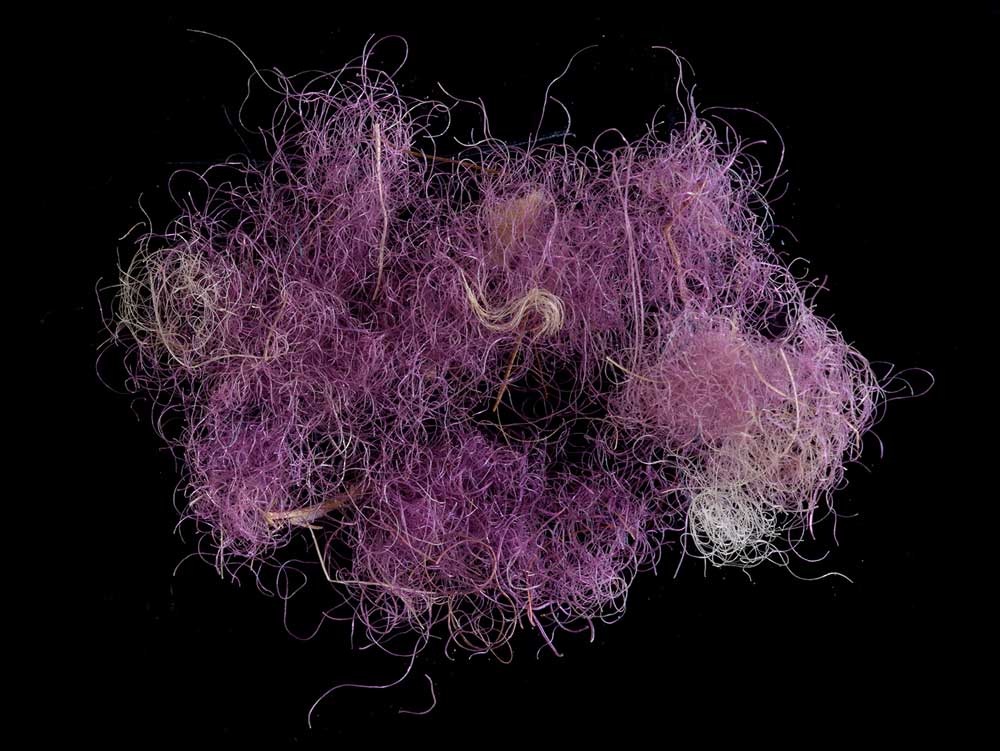
In a remarkable recent development, a fragment of cloth dyed with genuine Tyrian Purple was discovered in Carlisle in the UK, making it one of the most significant textile finds in British archaeological history. The tests to confirm the dye’s identity took considerable time — Tyrian Purple’s molecular signature (a brominated derivative of the indigo molecule, with bromine atoms attached) is chemically specific and unmistakable once identified. The fragment provides extraordinary evidence of the reach of Phoenician and Roman luxury trade into northern Britain.
My Own Homage to Tyrian Purple
When I came across the Carlisle discovery during my research for this module, I was immediately inspired to try and recreate the colour using the yarns I had to hand. Working from photographs of the excavated fragment and my own drawing of it, I focused on the deep, complex purple-red tones — somewhere between burgundy, violet and wine.
I used a combination of purple and cream 2-ply cotton yarn, held double with a burgundy mohair (also 2-ply), knitting in garter stitch over 20 stitches on US6 (4.0mm) needles. I added the cream yarn using stranded and intarsia techniques to create the lighter blobs and streaks visible in the original sample, and incorporated seed beads in a deep, vibrant purple to reflect the colour’s richness. The colour recreation I am happy with — but I would not knit with seed beads again, as the yarn was not sturdy enough to bear their weight. Lessons learned the enjoyable way.


Leave a Reply