


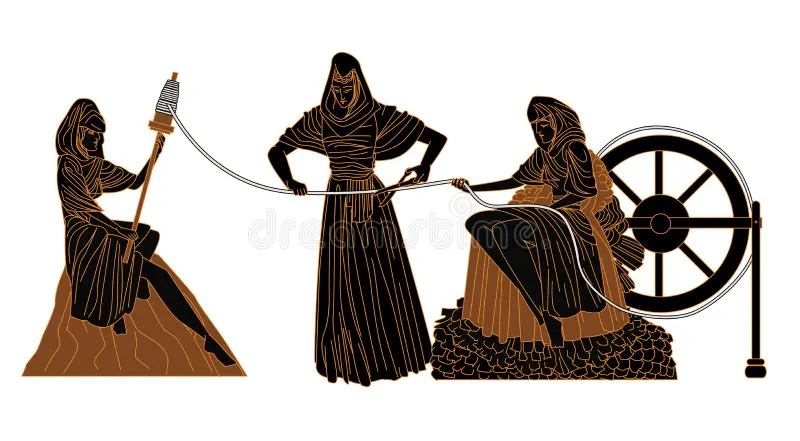
The ancient origins of yarn – before knitting needles, before spinning wheels, someone had to invent yarn itself.
When you pick up a skein of merino and begin to cast on, you are participating in a tradition that stretches back further than recorded history. Far further, in fact, than most of us imagine. Yarn – or at least twisted cord – is not a modern invention. It is arguably humanity’s oldest surviving technology.
In 2020, researchers confirmed that a fragment of three-ply cord found in a French cave had been made by Neanderthals, somewhere between 41,000 and 52,000 years ago. The cord was constructed from the inner bark of a conifer tree, twisted into multiple plies – the same basic structure that underpins every skein you’ll ever buy. To create a multi-ply twisted structure, you need to hold an abstract concept in your mind: the understanding that twisting in one direction and then plying in the opposite creates something stronger than either strand alone. This cognitive ability to plan and execute complex fibre work is not, it turns out, uniquely human.
“The cognitive ability to understand and create twisted, multi-ply structures predates modern humans in Europe. Yarn was not our invention – we inherited it.”
The Drop Spindle: 20,000 Years of Elegant Engineering
For many thousands of years, the key tool of yarn production was the drop spindle – a stick weighted with a whorl of stone or clay, which was spun by hand to twist raw fibre into a continuous thread. Simple in principle, extraordinary in effect. Evidence for its use reaches back at least 20,000 years – with twisted-cord ‘string skirts’ visible in Upper Palaeolithic cave art and figurines across Europe.
A skilled Egyptian spinner using this same drop spindle could produce thread so fine that historians have described it as “woven air,” with counts of up to 200 threads per centimetre. No machine invented since has truly improved on that fineness. This drop-spindle technique remained the foundation of yarn production for thousands of years, right up until the Industrial Revolution.
Why Yarn Changed Everything
Three forces drove humanity’s obsession with yarn: survival, trade, and status. Textiles are what allowed us to migrate out of warm climates and into the cold – the mountains, the poles, eventually space. To do that, early humans had to figure out how to grow fibre, harvest it, process it, and spin it at scale.
Cotton was among the first commodities traded globally, followed by wool. The Silk Road – named for the most prized fibre of all – connected China to the Mediterranean for over a thousand years. And from the very beginning, what you wore announced who you were. Sumptuary laws in Rome and medieval Europe legally restricted which fabrics and colours certain social classes could wear. Clothing has always been a political act as much as a practical one.
The Very First Dyed Yarn
The desire to colour yarn appears to be as old as the desire to make it. The earliest evidence of yarn dyeing comes from a Neolithic site in Anatolia (modern-day Turkey), where traces of red dye – possibly ochre – were found on flax fibres. Even more remarkably, in the Dzudzuana Caves in Georgia, flax fibres estimated to be around 30,000 years old were found cut, twisted and dyed in grey, black, turquoise and pink.
The world’s first known hand-dyers were not crafting for function. They were crafting for beauty. Some things never change.


Leave a Reply